Spent a Fortune on an Inline Defect Inspection System, Only to Find It Catches Major Defects While Missing Minor Ones?
See True Colors, Catch "Invisible" Defects.
In the field of surface defect inspection, most peers still rely on solutions combining monochrome cameras and software algorithms. Monochrome cameras identify defects based on grayscale differences. While they are effective for routine issues like scratches, abrasions, and spots, they often struggle with subtle "low-contrast" defects. For instance, faint yellow stains on nonwoven fabrics, minor coating skips on paint protection film (PPF), or light color variations on film surfaces—these defects exhibit minimal grayscale changes, blending almost seamlessly with the background in monochrome images. Traditional algorithms find it difficult to capture them reliably. The result is a high missed detection rate, continuous customer complaints, and immense pressure on the production line。
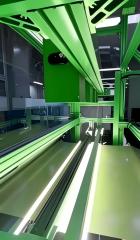
Our inline surface defect inspection system utilizes color industrial cameras and intelligent color image algorithms to fundamentally solve this challenge. Color cameras fully capture the color information of defects. They not only reveal "if" a defect exists but also distinguish "what color" it is. Subtle color variations, such as faint yellow, light red, and slight blue, are clearly identifiable in color images. By integrating deep learning algorithms tailored for color spaces, the system accurately identifies and classifies various defects, significantly reducing missed detections and false alarms. Simultaneously, it retains the high sensitivity of monochrome cameras, enabling the concurrent detection of both routine and color-related defects.More importantly, color inspection is not just a matter of swapping in a different camera. We optimize the light source, color and chromaticity settings, and algorithm models for different processes involving nonwoven fabrics, PPF, films, and coating materials.This ensures stable imaging and reliable alarms even under high-speed production conditions. Color is an integral part of quality; inspection cannot be limited to black and white. Choosing color visual inspection is not just a nice-to-have feature; it makes quality control truly comprehensive. We make subtle defects visible and are committed to safeguarding the factory quality of every meter of material.